Highlighted News
A Butterfly Garden - A Garden with Wings
· Escape Garden Design, Aspen, Colorado
Attract a Butterfly?
Two Years ago, we completed the plantings for a Butterfly Garden in Aspen. Last year, while finishing up another area of the property, it was fun to see more and more butterflies visiting the garden.
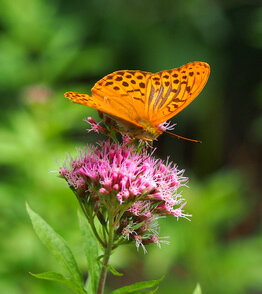
This butterfly garden had a special meaning to the client. The client associated butterflies with a close family member who is no longer alive. When we first discussed the project during the design phase, I thought that just maybe I could help her with that loss in a healing re-juvinating way. The approach turned into a massive planting designed to attract and foster the local Butterfly population.
It is estimated that there are over 15,000 species of butterflies throughout the world. Although some butterflies can live a year or more most adult butterflies only live two to three weeks. Butterflies are usually territorial but the Monarch will migrate thousands of miles each year from Canada to Mexico.
In the past, I have used plants that attract butterflies many times, however this was different because of the special meaning butterflies had for the client. So I enlisted the assistance of a butterfly expert, Professor Paul A. Opler, Department of Bioagricultural Sciences and Pest Management, Colorado State University, to help me design a garden with the greatest chance for success.
Five Principles to Follow in Attracting Butterflies
In Professor Opler's words, the general principals to attract butterflies are:
1. Plant both caterpillar hosts and nectar sources in close proximity to each other for each species.
2. Plant for a seasonal succession. This means to plant so that there is always something blooming or offering an appealing nectar source.
3. Plant important hosts and nectar plants in large groupings, not as single isolated plants.
4. Select native plant species wherever possible.
5. Have paths or walkways so clients may walk through garden to observe and photograph the butterflies.
Plants That Attract Most Species of Butterflies
As important nectar plants Professor Opler emphasized those used by the most species.
Sulphur-flower Buckwheat
Native or New England Aster
Stinging Nettle
Wild Currant
Native Lupines
Ceanothus
Gambel Oak
Broadleaf Meadow Grasses
Tower Mustard
Rock Cresses
Toothwort
Willows
Rudbeckia
Native Clovers
Some of the above also serve as host plants, in addition he added pink bergamont, lilacs, rabbitbrush (gray leaf), native thistles, white sweet clover, red valerian, and alfalfa.
Plant List
Due to some of the invasive tendencies of a few of the above species we did not use all of them. Below is the planting plan we used after carefully matching host plants with nectar sources, and the plant list for this project.
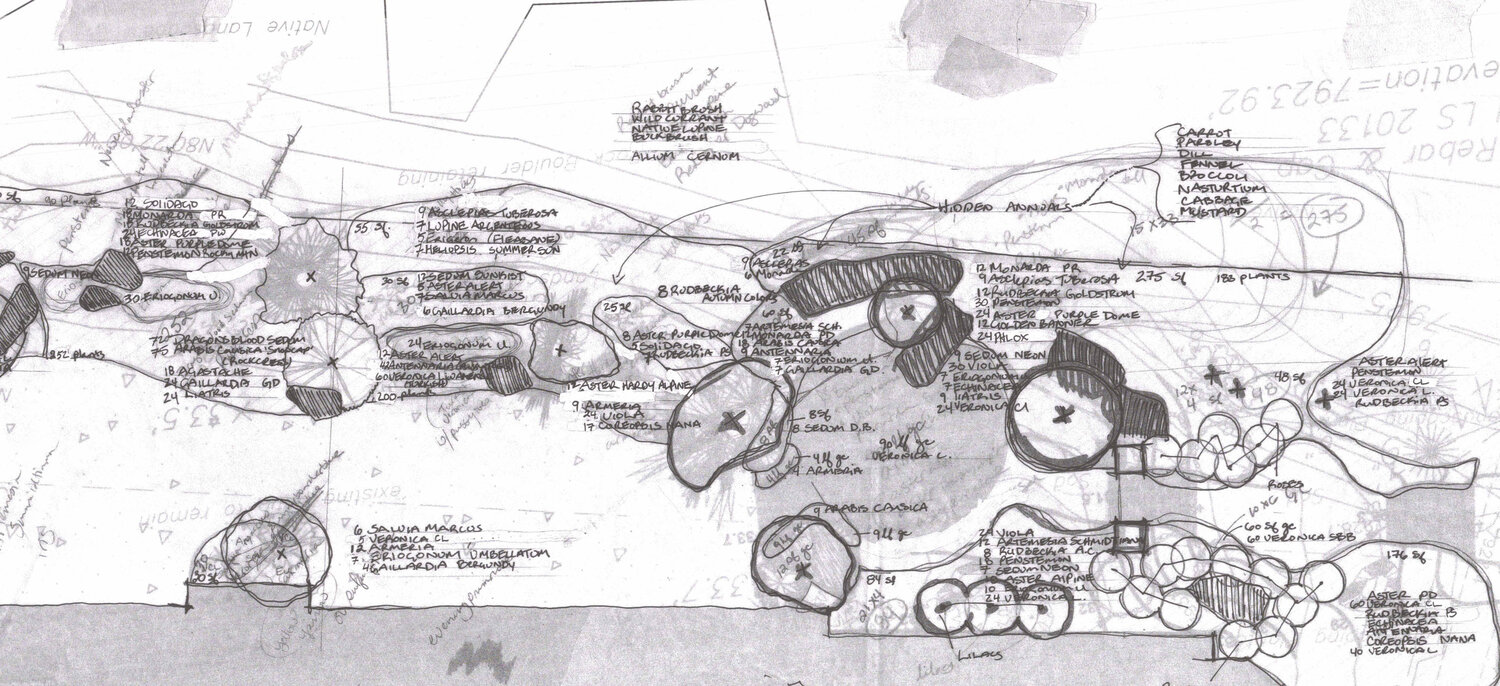
| Latin Name | Common Name |
|---|---|
| agastache aurantiaca 'coronado' | Hyssop |
| Arabis Caucasica 'snowcap' | Rock Cress |
| Armeria | Sea Thrift |
| Antennaria | Pussytoes |
| Artemesia Schmidtiana | Artemesia |
| Asclepias tuberosa | Butterfly Weed |
| Aster Alert | Aster Alert |
| Aster Alpinus (Native Aster) | Hardy Alpine Aster |
| Aster Purple Dome | Aster Purple Dome |
| Coreopsis Grandiflora? | Coreopsis Nana |
| Echinacea purpurea POW WOW | Purple Cone Flower |
| Erigeron Speciosus | Fleabane |
| Eriogonum umbellatum Kannah Creek | Sulphur Flower Buckwheat |
| Gaillardia aristata Bergundy | Gaillardia |
| Gaillardia Golden Goblin | |
| Gaillardia grandiflora goblin dwarf | |
| Heliopsis Summer Sun | False Sunflower |
| liatris spicata | liatris |
| Lupine Argenteus | Lupine Argenteus |
| Monarda didyma Panoramma Red | Pink Bergamont |
| Monarda didyma Petite Delight | Pink Bergamont |
| Penstemon mexicali 'Shadow Mountain' | Penstemon |
| Penstemon strictus | Rocky Mountain Penstemon |
| Phlox Paniculata purple kiss | Phlox |
| Rudbeckia Fulgida Goldstrum | Black Eyed Susan |
| Rudbeckia Hirta Autumn Colors | Black Eyed Susan |
| Rudbeckia Hirta Prairie Sun | Black Eyed Susan |
| Salvia Marcus | |
| Sedum Spurium Dragons Blood | Dragons Blood Sedum |
| Sedum Sunkissed | |
| Sedum Neon | |
| Solidago | Goldenrod |
| Thermopsis Divaricarpa | Golden Banner |
| Veronica Liwanensis | Turkish Veronica |
| Veronica Crater Lake | |
| Viola corsica | Native Violets |
| Chrysothamnus Nausious Ericameria | rabbitbrush dwarf blue |
| lupinus argenteus | native lupine |
| allium cernuum | Wild Onion |
| artemesia frigida | sages |
| Veronica Liwanensis | Turkish Veronica |
| Annuals | |
| Origanum | Oregano |
| Mentha × piperita | Peppermint |
| brassica | Cabbage |
| Brassica | Broccoli |
| dill | |
| parsley | |
| Nasturtium | Watercress |
| syringa | Lilacs |
You can get more information from Professor Opler from the many books he has written or contributed to:
1. Butterflies of North America, an activity and coloring book
[artist Susan Strawn] ISBN 1-57098-435-2 paper, $ 9.95 retail
Order from Rowman and Littlefield Publishing Group, 4501 Forbes Blvd., Suite 200, Lanham, MD 20706 www.roberts-rinehart.com
2. First Guide to Butterflies and Moths, Peterson First Guide
With Amy Bartlett Wright, ISBN 0-395-90665-2 paper, retail $ 5.95
3. Peterson Field Guide to Eastern Butterflies
ISBN 0-395-90453-6 paper, retail $ 20.00
4. Peterson Field Guide to Western Butterflies
ISBN 0-395-79152-9 cloth, retail $32.00
ISBN 0-395-79151-0 paper, $24.00
5. Butterflies, Peterson FlashGuide
ISBN 0-395-82996-8, retail $7.95 U.S.,
Order # 2, 3, 4, & 5 from Houghton Mifflin Co.
Wayside Road, Burlington, MA 01803
1-800/225-3362; www.hmco.com
7. Audubon Videoguide to Butterflies: Essentials for Beginners and Gardeners (DVD), Retail $40.00
8. Audubon Videoguide to Butterflies: Common & Endangered
(DVD), Retail $40.00
Order both DVDs from MasterVision, 969 Park Ave., New York, NY 10028
212/879-0448; 410/516-6994; www.mastervision.com
9. Moths of Western North America
With J.A. Powell, ISBN- 0-520-25197-0, Retail $95.00 [cloth]
Order from California Princeton Fulfillment Services, 609-883-1759, FAX 609-883-7413, www.ucpress.edu
Note: You can view some of Paul Opler's and Evi Buckner-Opler's images on the world-wide web home page at www.butterflyfotos.com or contact Paul or Evi via e-mail